


مدونة
Saffron First Irrigation: Best Time for Flower Water | Kimia Lagon
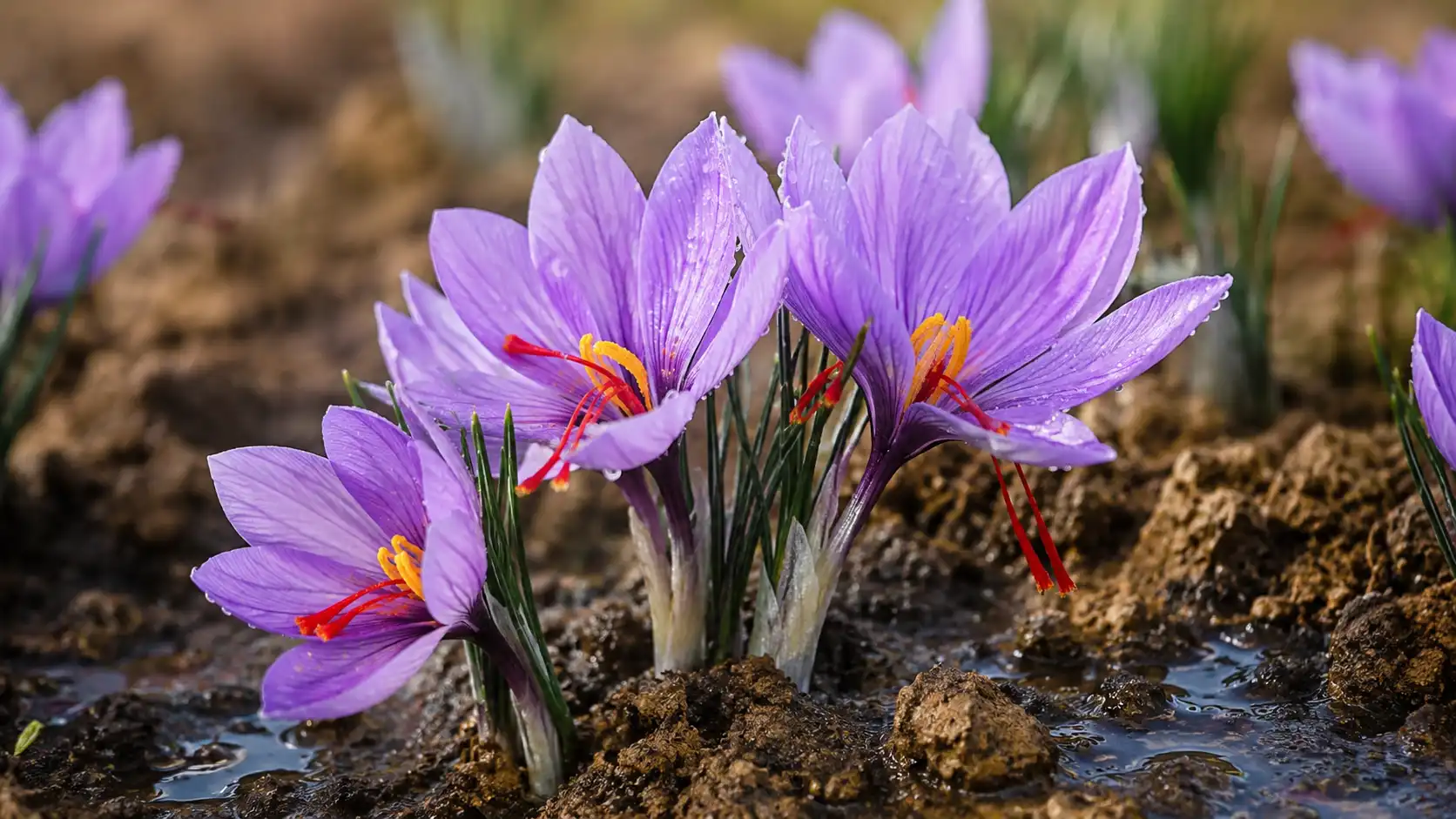
Saffron First Irrigation: Best Time for Flower Water
Saffron first irrigation—known in some producing regions as Gol-Ab, flower water or Basar-Ab—is one of the most influential operations at the beginning of the saffron season. Its purpose is not simply to add water; correct timing helps create the soil and temperature conditions required for corm activation, rapid bud growth and flower emergence.
9-minute guide
Late summer to flowering
Field decision framework
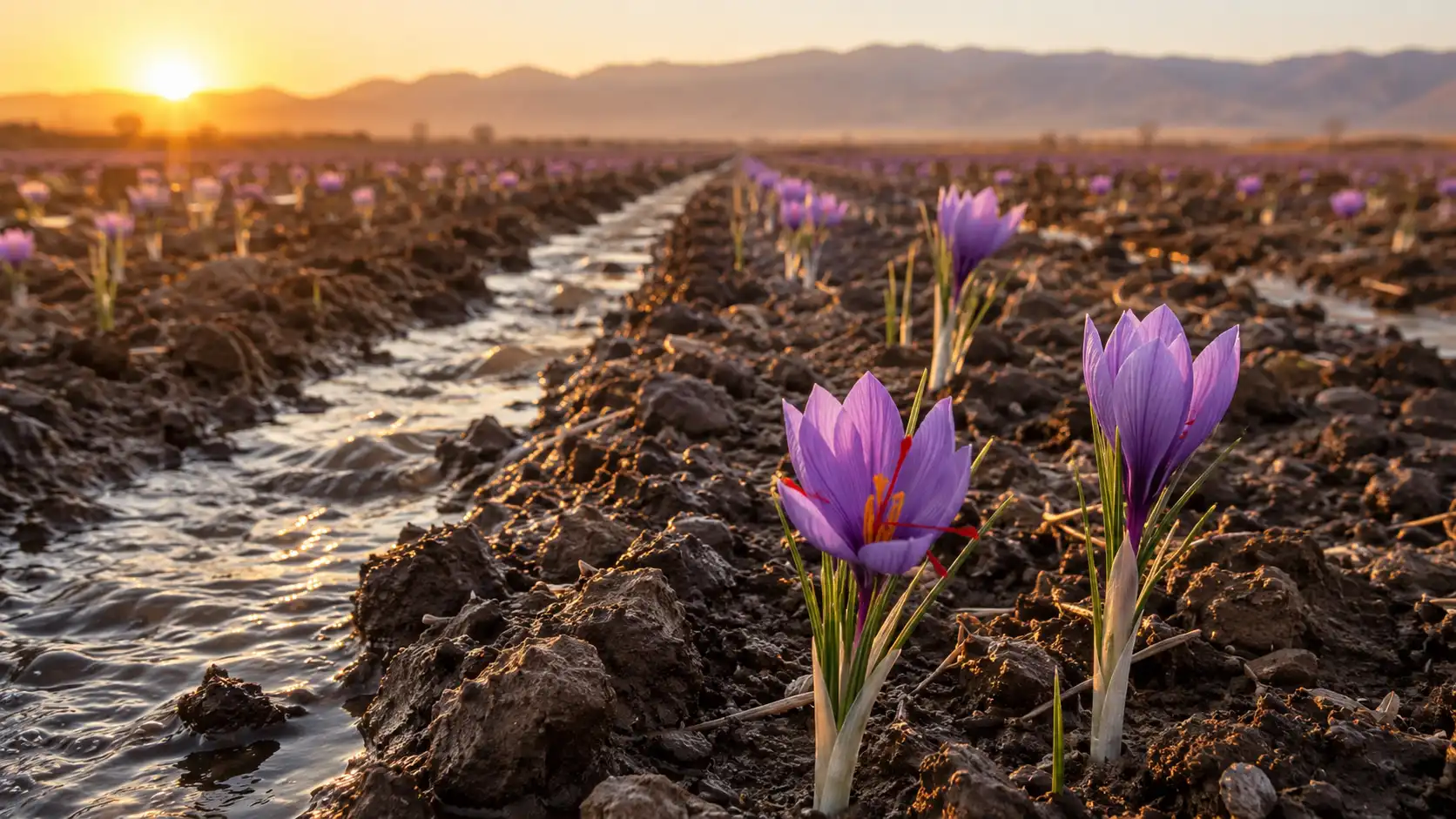
Timing matters more than volume
Use corm readiness, temperature and root-zone moisture—not the calendar alone—to decide when to irrigate.
Saffron First Irrigation in 30 Seconds
Do not schedule saffron first irrigation by date alone. Apply the main pre-flowering irrigation when air and soil temperatures are falling toward suitable autumn conditions, the corms are leaving summer dormancy and root-zone moisture shows that water is needed. In many fields, one well-timed main irrigation before flowering is enough; extra water does not automatically produce more flowers.
What Is Saffron First Irrigation?
Saffron first irrigation is the first major irrigation given to a saffron field before flower emergence. In Iranian saffron-growing terminology it is commonly called Gol-Ab, flower water or Basar-Ab. It marks the practical start of the new production season after the dry summer period.
The operation should not be viewed as ordinary watering. By changing root-zone moisture at the same time that autumn temperatures begin to decline, saffron first irrigation helps provide the conditions that allow prepared buds inside the corm to begin rapid growth and move toward the soil surface.
Autumn irrigation does not create a flower from zero. Much of floral differentiation has already occurred inside the corm during summer; irrigation mainly provides the conditions needed for growth and emergence.
Restores root-zone moisture
Water becomes available around the corm and active root zone after the dry summer period.
Supports bud growth
Suitable moisture and cooling conditions allow the already differentiated bud to elongate rapidly.
Starts the field season
The operation links the end of summer rest with the beginning of visible autumn growth and flowering.
Deep Dormancy and Apparent Dormancy in Saffron Corms
The terms “deep dormancy” and “apparent dormancy” are useful for explaining the summer condition of saffron corms, but they should not be treated as two perfectly separate and fixed physiological stages. The transition is gradual, and important internal processes continue even when the field appears inactive.
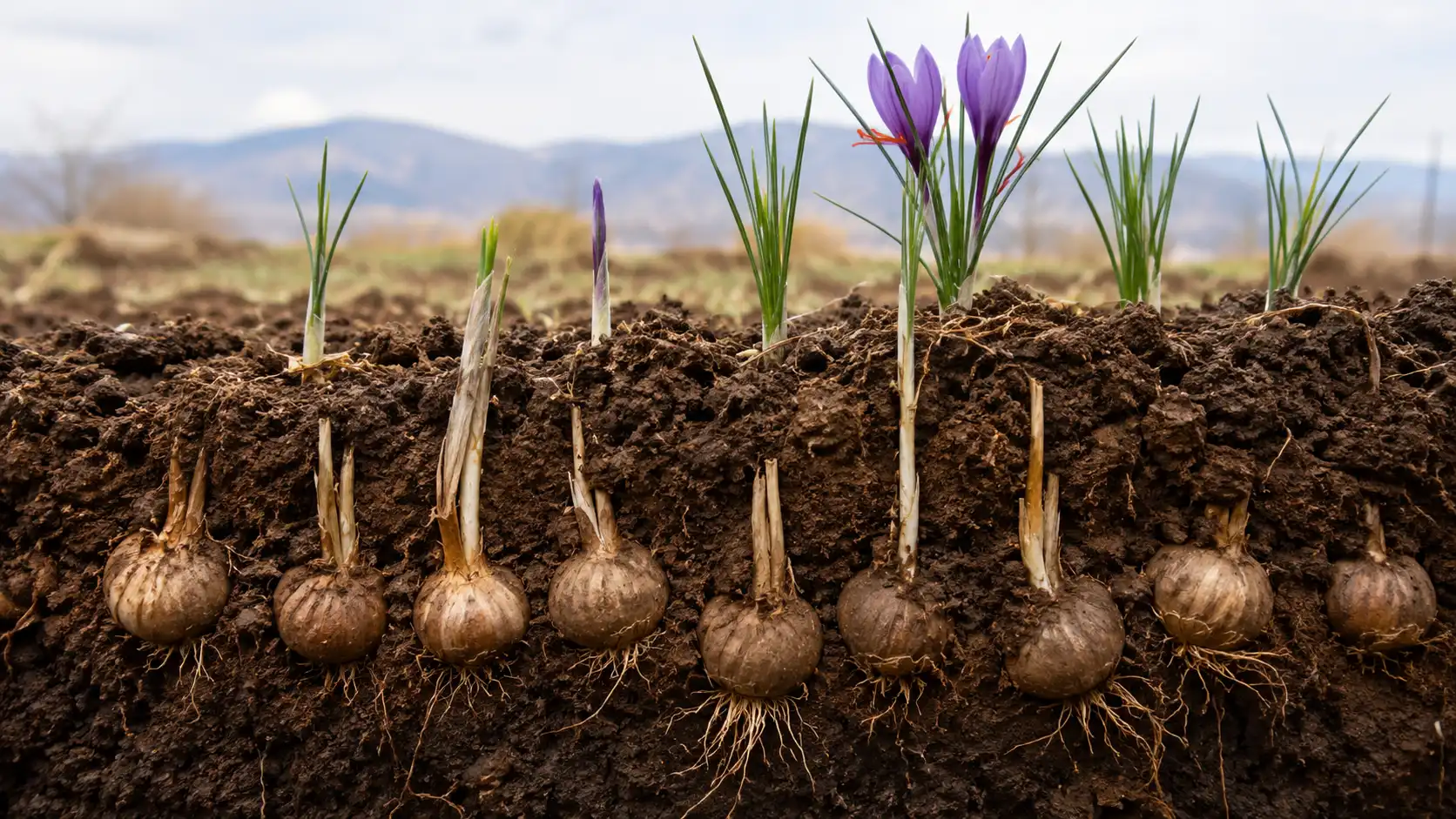
End of spring growth
After vegetative growth ends, saffron leaves turn yellow and dry. No visible canopy remains above the soil.
Summer rest or deep dormancy
Root activity is extremely low, buds do not yet show visible elongation and the corm relies on stored carbohydrates. High summer temperature plays an important role in hormonal processes and floral differentiation.
Hidden internal development
Although the field can look completely “dead,” the corm is not fully inactive. Flower organs continue differentiating, and changes in starch and soluble-sugar metabolism support the flowering process.
Late-summer readiness
The corm gradually leaves deep dormancy. The internal bud becomes active but remains below the soil. When moisture becomes suitable and temperature declines, rapid growth can begin.
No visible growth does not mean no physiological activity
By late summer, flower differentiation may already be complete or close to completion even though no shoot is visible at the soil surface.
When Is the Best Time for Saffron First Irrigation?
The best time for saffron first irrigation should be selected from field conditions rather than from a fixed date. After a dry summer, rising soil moisture, a larger difference between day and night temperature and the approach of cooler autumn weather together create favorable conditions for root activation and bud growth.
Timing is more important than simply increasing the volume of water. If irrigation is applied too early while air and soil remain hot, vegetative growth may be stimulated prematurely and leaves may appear with—or even before—the flowers. If irrigation is delayed too long, the beginning of flowering may also be delayed.
Well-timed irrigation
- Matches declining autumn temperature.
- Responds to actual moisture at corm depth.
- Supports rapid bud growth and flower emergence.
- Is adjusted for local soil, climate and field condition.
Poorly timed irrigation
- Is triggered only because a calendar date has arrived.
- Ignores hot soil or remaining root-zone moisture.
- May bring leaves forward or delay flowering.
- May increase disease or corm-rot risk in unsuitable soil.
A regional date is not a universal recommendation
Field observations in Khorasan reported that first irrigation was most frequently applied from late Mehr to mid-Aban—roughly late October to early November. This pattern changes with year, altitude, climate and farm conditions and should not be copied as a fixed date elsewhere.
Three Factors That Determine Saffron Irrigation Timing
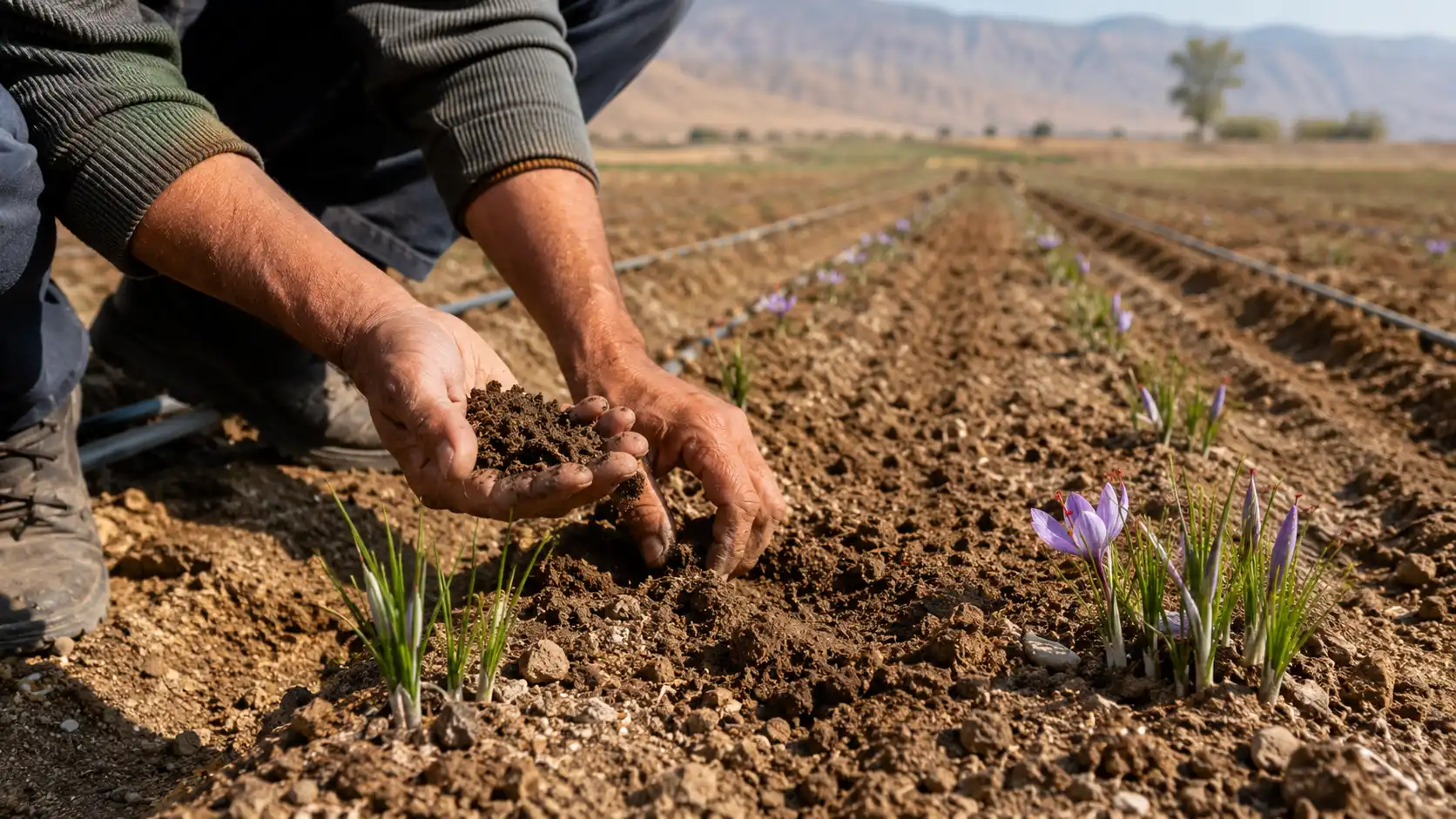
A practical saffron first irrigation decision combines air temperature, soil temperature and soil moisture. No single factor should be used in isolation.
1. Air temperature
Cooling autumn weather supports flower emergence. Around 14–16°C has been reported as a useful range for considering first irrigation in some climates, followed by lower temperatures during flowering. It is an indicator, not a universal threshold.
2. Soil temperature
Soil temperature is often more informative than air temperature because the corm is located below the surface. A cool night does not necessarily mean the corm zone has cooled enough.
3. Root-zone moisture
Check moisture at the actual corm depth. If sufficient moisture remains in the soil, irrigating only because the usual date has arrived can be unnecessary or harmful.
| Decision factor | What to inspect | Why it matters | Management response |
|---|---|---|---|
| Air temperature | Daily trend, night cooling and local forecast. | Autumn cooling supports the transition toward flower emergence. | Use the trend together with soil conditions; do not rely on one cool day. |
| Soil temperature | Temperature near the corm depth in representative field zones. | The corm responds to the environment surrounding it below ground. | Delay irrigation if the root zone remains excessively warm for the local system. |
| Soil moisture | Actual moisture at corm depth, not only at the surface. | Existing moisture changes the field’s need for irrigation. | Do not irrigate automatically when adequate moisture is already present. |
| Soil texture and drainage | Heavy zones, slow infiltration, standing water and compaction. | Poor drainage can increase the danger of corm damage and fungal disease. | Adjust water volume and duration to avoid prolonged saturation. |
| Field history | Previous flowering dates, disease history and irrigation response. | Past field behavior helps interpret current conditions. | Record each season so future decisions are based on evidence rather than memory. |
How Many Irrigations Are Needed Before Saffron Flowering?
Two different operations are often confused: optional late-summer irrigation and the main saffron first irrigation before flowering. They do not have the same purpose, and not every field requires both.
Optional late-summer irrigation
In some regions and special conditions, a light to moderate irrigation is applied in late summer to help stimulate or improve uniformity of the flowering process. The source material notes that this practice is not conclusively established for every region and is mainly considered where summer dryness and heat are severe.
Main flower water irrigation
This is the principal irrigation applied before flower emergence. In many ordinary field situations, one correctly timed main irrigation is enough before flowering.
Several irrigations before flowering are not automatically better. Extra watering without a real moisture need does not guarantee more flowers and can create additional field problems.
If the field is very dry and local conditions justify it
A light to moderate late-summer irrigation may be considered, followed later by the main flower water irrigation at the correct autumn timing.
If no summer irrigation is used
Apply the main saffron first irrigation at the appropriate autumn time, using temperature and soil moisture as the principal field indicators.
After the first irrigation
Schedule later irrigations according to actual moisture demand, rainfall, soil properties and local field management—not according to a rigid universal sequence.
Why Very Early Summer Irrigation Can Be Dangerous
Very early irrigation is one of the most important risks in saffron field management. When air and soil are still hot and the corm is completing its summer processes, adding water can disturb the intended seasonal sequence.
Premature root activation
Moisture may stimulate root activity before environmental conditions are suitable for the normal flowering transition.
Early vegetative growth
Vegetative buds may be stimulated too soon, bringing leaf emergence forward and potentially causing leaves to appear with or before flowers.
Fungal disease pressure
Warm soil combined with added moisture can create favorable conditions for fungal problems.
Corm rot in heavy soil
Where drainage is poor, excess or poorly timed irrigation can increase the risk of prolonged saturation and corm decay.
More water does not equal more saffron flowers
Water volume cannot compensate for poor timing. Excess irrigation can reduce field safety even when the intention is to stimulate flowering.
A Practical Saffron First Irrigation Decision Plan
Use the following sequence before opening the irrigation system. The order is designed to prevent calendar-based watering and to keep the decision connected to corm physiology and field conditions.
Review the recent temperature trend
Look for sustained autumn cooling rather than one temporary cold night.
Measure or inspect soil conditions at corm depth
Check both soil temperature and moisture in several representative areas of the field.
Evaluate texture, drainage and disease risk
Pay special attention to heavy, compacted or historically waterlogged zones.
Decide whether summer irrigation is truly justified
Do not add a separate late-summer irrigation merely because another farm uses one.
Apply the main irrigation uniformly
Match the amount and duration to field capacity, soil type and irrigation-system performance without creating prolonged saturation.
Record the field response
Document irrigation date, weather, soil condition, flower emergence, leaf timing and any disease symptoms for next season’s decisions.
Six Saffron Irrigation Mistakes to Avoid
1. Irrigating only because a traditional date has arrived
The correct date changes with year, climate, altitude, soil and remaining moisture.
2. Treating flower water as routine irrigation
Saffron first irrigation is a physiological and thermal management decision, not only a water-delivery operation.
3. Assuming several irrigations will increase flowering
Additional water without a moisture need does not guarantee a larger flower count.
4. Ignoring soil temperature
Air may cool faster than the corm zone; the below-ground environment deserves direct attention.
5. Overwatering heavy or poorly drained soil
Long wet periods can increase the risk of fungal disease and corm damage.
6. Treating pre-flowering fertilizer as a flower switch
Nutrition should be conservative and based on soil testing and field need. Fertilizer cannot replace correct corm development or irrigation timing.
Saffron First Irrigation Checklist
Use this checklist before irrigation. Your selections are saved in this browser.
Pre-irrigation field checks
Before Adding Fertilizer to the First Irrigation
One of the most common management errors is treating pre-flowering fertilization as a direct flower stimulant. The source article emphasizes that nutrition at this stage should be conservative, field-specific and supported by soil testing.
Use soil and field information
Base any input on soil test results, field history, irrigation-water conditions and a defined agronomic need.
Do not use fertilizer as a flowering switch
Flower differentiation has largely occurred during summer. Fertilizer cannot compensate for incorrect timing or unsuitable corm conditions.
Consider salinity and compatibility
Any material added through irrigation must fit the soil, water and application system and should not increase stress around the corm.
Adjust the program to the production region
Climate, soil texture, planting depth and irrigation method change the correct management response from one farm to another.
Need help reviewing your saffron irrigation conditions?
Send the Kimia Lagon technical team your location, soil texture, corm depth, irrigation method, recent temperature trend, soil-moisture condition and any available soil or water analysis. A useful recommendation requires actual field information—not only a calendar date.
Final Recommendation for Saffron First Irrigation
The most important principle is simple: determine saffron first irrigation from the gradual exit of the corm from summer dormancy, the decline in air and soil temperature, actual moisture at corm depth and the physical condition of the field. Do not interpret the operation as ordinary watering, and do not assume that more water will create more flowers.
A large part of the flower’s developmental pathway has already been completed inside the corm during summer. Correct autumn irrigation mainly enables prepared floral organs to grow and emerge. Therefore, professional management depends on timing, measurement, drainage and field records—not on a universal date or a fixed number of irrigations.
Technical References
The physiological and irrigation principles summarized in this guide are based on the source article and the references listed below.
- Behdani, M. A., Mahallati, M. N., & Koocheki, A. (2008). Evaluation of irrigation management of saffron at agroecosystem scale in dry region of Iran.
- Molina, R. V., Valero, M., Navarro, Y., Guardiola, J. L., & Garcia-Luis, A. (2005). Temperature effects on flower formation in saffron (Crocus sativus L.). Scientia Horticulturae, 103(3), 361–379.
Saffron First Irrigation FAQ
Saffron first irrigation, also called flower water or Gol-Ab, is the main irrigation applied before flower emergence. It creates suitable moisture conditions for corm activation, rapid bud growth and flower emergence as autumn temperatures decline.
The best time depends on sustained autumn cooling, soil temperature, moisture at corm depth, soil properties and local field history. It should not be selected from a fixed calendar date alone.
No. Around 14–16°C has been reported as a useful air-temperature range for considering first irrigation in some climatic studies, but it is not a universal threshold. Soil temperature, moisture and local conditions must also be evaluated.
In many fields, one correctly timed main irrigation before flowering is enough. A separate late-summer irrigation may be considered only in specific dry and hot conditions where local experience and field need support it.
It can create problems when air and soil remain hot. Early water may stimulate roots and vegetative buds, advance leaf emergence and increase fungal disease or corm-rot risk, especially in heavy or poorly drained soils.
No. Additional irrigation without a real moisture requirement does not guarantee more flowers and may increase waterlogging, disease or corm-damage risk. Timing and field need are more important than simply adding water.
KL
Kimia Lagon Agronomy Content
This guide is educational and does not replace field-specific agronomic advice. Irrigation timing and volume must be adjusted for climate, soil texture, corm depth, drainage, irrigation method and current root-zone moisture.