


Blog
The Importance of Phosphorus in Plants and Types of Phosphorus Fertilizers

The Importance of Phosphorus in Plants and Types of Phosphorus Fertilizers
Phosphorus is one of the three primary macronutrients alongside nitrogen and potassium in plant nutrition[cite: 1]. While nitrogen is considered the main factor in vegetative growth, phosphorus plays a key role in energy transfer, root growth and development, plant reproduction and increasing plant resistance[cite: 1].
Phosphorus Management in 30 Seconds
Phosphorus is a major component of compounds such as ATP and directly plays a role in the processes of photosynthesis, respiration, and cell division[cite: 1]. The plant mainly absorbs phosphorus in the form of phosphate ions H₂PO₄⁻ and HPO₄²⁻, with a soil pH between 6 and 7 being optimal for absorption[cite: 1]. Diagnosis is difficult, but dark green older leaves with a purple underside indicate deficiency[cite: 1]. Base fertilizer choices on soil tests, avoiding highly fixing practices like surface spreading in calcareous soils[cite: 1].
The Role of Phosphorus in Plants
Supplying phosphorus in the early stages of growth is very important and vital for the development of the root system[cite: 1]. Phosphorus deficiency at the beginning of the growing season will cause reduced root growth, reduced development of lateral roots, weakness in plant establishment and reduced ability of the plant to absorb water and nutrients[cite: 1].
Phosphorus is present in the structure of proteins, fats and nucleic acids and is essential for the synthesis of DNA and RNA molecules and the genetic structure of the plant[cite: 1].
Energy transfer
Phosphorus is a major component of adenosine triphosphate (ATP), the energy currency of the cell necessary for photosynthesis and metabolism[cite: 1].
Root system
Early application ensures the growth and development of lateral roots, aiding successful plant establishment[cite: 1].
Reproduction
It plays a role in flowering and the formation of reproductive organs, as well as the transfer of photosynthetic materials[cite: 1].
Identifying Phosphorus Deficiency
Diagnosing phosphorus deficiency is usually difficult because its symptoms in the early stages may be minor and become clearly visible when it is a little late for correction[cite: 1].
Early minor symptoms
In the early stages, signs of deficiency are subtle and hard to identify correctly[cite: 1].
Older leaf changes
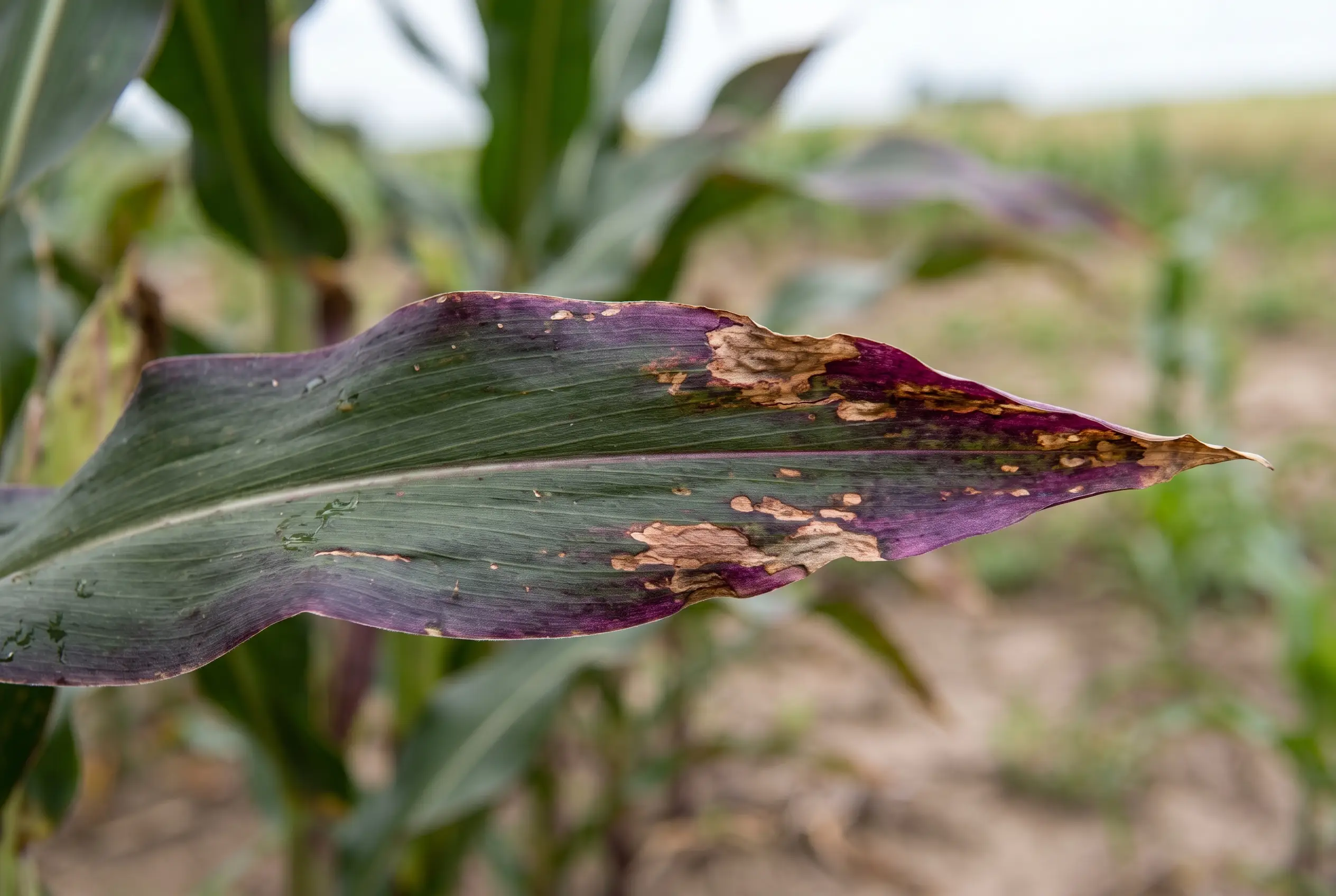
The characteristic sign appears on older leaves where the leaf margins become an abnormal dark green[cite: 1].
Purple coloration
The underside of the leaf becomes purple, and as the deficiency progresses, older leaves become generally purple[cite: 1].
Severe signs
Brown spots develop on the leaf margins, and root growth directly disrupts, absorbing even less phosphorus[cite: 1].
Cold conditions increase phosphorus deficiency which, if there is a sufficient level of phosphorus in the soil, usually disappears as the weather warms[cite: 1].
Phosphorus Removal and Use Efficiency
In intensive and modern agricultural systems on irrigated lands, the annual phosphorus removal is 35-20 kilograms per hectare[cite: 1]. It has been estimated that phosphorus removal from a field with a yield of 10 tons per hectare of wheat is about 40 kilograms, from a canola field with a yield of 4 tons per hectare is about 30 kilograms, and in a potato field with an average yield of 70 tons per hectare is about 40 kilograms per hectare[cite: 1].
High use efficiency
- Canola has suitable phosphorus use efficiency[cite: 1].
- Alfalfa demonstrates good uptake performance[cite: 1].
- Sugar beet is capable of efficient usage[cite: 1].
- Wheat ranks among plants with suitable efficiency[cite: 1].
Poor use efficiency
- Onion struggles with phosphorus absorption[cite: 1].
- Tomato is among the plants with poor efficiency[cite: 1].
- Bean crops often demonstrate poor use efficiency[cite: 1].
- Most fruit trees fall into this category[cite: 1].
The amount of phosphorus removed from the soil does not determine the amount of phosphorus requirement, rather phosphorus use efficiency is important[cite: 1].
Highly Soluble Mineral Phosphorus Sources
The selection of each phosphorus supply source depends on soil chemistry, time of application relative to planting, method of application and production objective[cite: 1].
MAP (11-52-0)
The initial reaction of its solution is relatively acidic, making MAP in many conditions, especially alkaline soils, a very good choice[cite: 1].
DAP (18-46-0)
Offers the advantage of simultaneously supplying nitrogen and phosphorus and is much more common than MAP[cite: 1].
TSP (0-46-0)
Very soluble phosphorus without nitrogen, making it a suitable option in conditions where the soil does not need N[cite: 1].
| Fertilizer type | Characteristics | Application | Key notes |
|---|---|---|---|
| Monoammonium phosphate (MAP) | 11-52-0, highly soluble, acidic reaction[cite: 1]. | Preplanting, fertigation, band application[cite: 1]. | Very good choice for alkaline soils; suitable for early growing season in fruit trees[cite: 1]. |
| Diammonium phosphate (DAP) | 18-46-0, highly soluble[cite: 1]. | Preplanting[cite: 1]. | Appropriate distance from the seed must be maintained to avoid ammonia damage[cite: 1]. |
| Triple superphosphate (TSP) | 0-46-0, very soluble, zero nitrogen[cite: 1]. | Preplanting[cite: 1]. | Use when only phosphorus is needed and soil does not need N[cite: 1]. |
| Phosphoric acid | Very high concentration of phosphorus, corrosive[cite: 1]. | Raw material in fertilizer industries or special fertigation[cite: 1]. | Can reduce soil acidity toward greater absorption of micronutrients[cite: 1]. |
| Single superphosphate (SSP) | 0-16 or 21-0, contains calcium and sulfur[cite: 1]. | Various conditions[cite: 1]. | Has an advantage if the soil simultaneously needs sulfur[cite: 1]. |
Slow Release Mineral and Organic Sources
Aside from highly soluble types, agricultural systems rely on slow-release options. Organic phosphorus can be made available to the plant directly or after mineralization, but the rate of release depends on temperature, moisture, carbon to nitrogen ratio, microbial activity and type of organic matter[cite: 1].
Phosphate rock
Its total phosphorus can be high, but high phosphorus does not indicate high absorption[cite: 1]. It dissolves better and performs better in acidic environments, and is not a good option at all in calcareous and alkaline soils[cite: 1].
Organic fertilizers
This group includes types of animal manures such as poultry and cattle manure, vermicompost, plant residues and some organic fertilizers enriched with phosphorus[cite: 1].
Fixation reduction
Organic compounds can occupy some active sites in the soil and cause fewer phosphate ions to be fixed on soil surfaces and in reaction with other ions[cite: 1].
Organic acids
Decomposition of organic matter causes the production of organic compounds and organic acids that play a role in releasing part of the phosphorus[cite: 1].
Microbial support
Organic matter is an energy source for microorganisms which dissolve mineral phosphate and produce the phosphatase enzyme[cite: 1].
Risks of Incorrect Fertilizer Application
The existence of common mistakes in plant nutrition management will impose additional costs on the farmer without increasing the efficiency of phosphorus absorption and use[cite: 1].
Wrong Source for Soil
Applying phosphate rock in calcareous and alkaline soils is a common mistake that provides poor phosphorus absorption[cite: 1].
Seed Damage
When DAP is placed too close to the seed during preplanting, released ammonia can severely damage the seedling and root[cite: 1].
Ignoring Zinc
Simultaneous application of high phosphorus without attention to the amount of zinc in the soil can cause nutritional imbalances[cite: 1].
Calcium Conflict
Simultaneous use of phosphorus and calcium fertilizers at one irrigation time or at one point in the soil reduces absorption efficiency[cite: 1].

If the phosphorus required by the plant is supplied, consuming more of it does not necessarily increase yield[cite: 1].
A Practical Plan for Phosphorus Management
Sustainable phosphorus management involves improving efficiency and using alternative sources, especially in soils with limitations in supply or absorption[cite: 1].
Soil testing
Management is possible primarily through accurate soil testing instead of blind annual applications[cite: 1].
Select an appropriate source
Choose between highly soluble or organic sources based on soil chemistry and production objective[cite: 1].
Manage soil pH
The ratio of H₂PO₄⁻ to HPO₄²⁻ depends on soil pH, with the best absorption range being between 6 and 7[cite: 1].
Precise application
Apply phosphorus fertilizer at the appropriate time, ensuring distance from seeds for DAP and avoiding surface spreading in calcareous soils[cite: 1].
Use biological approaches
Incorporate microorganisms that produce organic acids to release fixed soil phosphorus[cite: 1].
Integrate organic matter
Use animal manures to increase phosphorus mobility, recovery, and improve soil structure[cite: 1].
Six Phosphorus Application Mistakes to Avoid
1. Annual application without soil testing
Applying fertilizer every year without verifying soil needs leads to inefficiency[cite: 1].
2. Very high application of TSP/DAP/MAP
Especially at the beginning of planting, done with the assumption that more phosphorus equals more yield[cite: 1].
3. Surface spreading before cultivation
Spreading phosphorus on the soil surface is problematic, especially in calcareous soils where the soil has a high fixation capacity[cite: 1].
4. High humic acid application alone
Applying humic acid without phosphorus fertilizers, assuming it alone will release fixed phosphorus[cite: 1].
5. Inattention to zinc
Simultaneous application of high phosphorus without monitoring the amount of zinc in the soil[cite: 1].
6. Simultaneous calcium application
Using phosphorus and calcium fertilizers at one irrigation time or at one point in the soil[cite: 1].
Phosphorus Management Checklist
Use this checklist before applying fertilizer. Your selections are saved in this browser.
Pre-application field checks
Maximizing Efficiency with Biological Approaches
Studies have shown that animal manures can both be a source of phosphorus and in some conditions be a factor in increasing phosphorus mobility and recovery[cite: 1].
Improve root conditions
The use of organic fertilizers helps improve soil structure, increasing overall phosphorus absorption[cite: 1].
Support soil microbes
Organic matter is an energy source for microorganisms that dissolve mineral phosphate and mineralize organic phosphorus[cite: 1].
Leverage phosphatase
Microbes produce organic acids and the phosphatase enzyme, increasing the usability of phosphorus present in the soil and chemical fertilizers[cite: 1].
Lower chemical dependence
Biological approaches reduce the overall need for the use of chemical fertilizers by releasing fixed soil phosphorus[cite: 1].
Need help selecting the right phosphorus fertilizer?
Send the Kimia Lagon technical team your soil test results, crop type, and field history. A proper recommendation requires exact soil chemistry and pH details—not just a generic application rate.
Final Word on Phosphorus Management
Scientific phosphorus management is achievable through rigorous soil testing, selecting the appropriate fertilizer source based on pH, and precise application timing[cite: 1]. Recognizing early deficiency signs and understanding the differences between highly soluble and slow-release options are fundamental steps in protecting crop yields.
Furthermore, sustainable management relies on improving absorption efficiency rather than simply applying more chemical inputs. Integrating biological approaches—such as organic matter and beneficial microorganisms—helps release fixed soil phosphorus, improving overall root health and reducing long-term fertilizer dependencies[cite: 1].
Technical References
The plant nutrition principles summarized in this guide are based on the following document provided for this analysis:
- Importance_of_Phosphorus_in_Plants_and_Types_of_Phosphorus_Fertilizers_EN.docx
Phosphorus Management FAQ
Phosphorus plays a key role in energy transfer (ATP), root growth and development, plant reproduction (flowering and seed formation), and increasing plant resistance[cite: 1].
Early diagnosis is difficult, but the characteristic sign appears on older leaves where the leaf margins become an abnormal dark green and the underside becomes purple[cite: 1].
The best pH range for phosphorus absorption by plants is between 6 and 7[cite: 1].
MAP (11-52-0) is relatively acidic and highly suitable for alkaline soils. DAP (18-46-0) supplies more nitrogen but creates an alkaline environment around the granule, which can cause ammonia damage if placed too close to the seed[cite: 1].
No, phosphate rock dissolves better in acidic environments and is not a good option at all for supplying phosphorus in calcareous and alkaline soils[cite: 1].
No, if the phosphorus required by the plant is already supplied, consuming more of it does not necessarily increase yield and imposes additional costs[cite: 1].